


LITIGATION AND COMPLEX CASES
Accounts change. Evidence accumulates. The case must remain whole.
A proceeding accumulates filings. A case accumulates claims, evidence, counterevidence, events, decisions, and changing accounts that rarely stay together.
Trailon organizes that structure so every argument can be examined in context and traced back to what supports it.
ClaimsArgumentsEvidenceCounterevidenceChronologyDecisions
Questions you can ask directly about the case.
Search does not stop at a filing containing a word. It can retrieve context between what was alleged, supported, challenged, and decided.
Which passage supports this argument?
Which counterevidence limits or challenges this reading?
Where did an account change over the case?
Which event connects filings made at different times?
How does a new decision change the existing strategy?
Ask about the case, not a folder. The platform finds relevant paths across accounts, events, actors, decisions, and evidence—with origin preserved.
Proceedings organize documents. Trailon reconstructs the case for examination.
Load the filings and start the analysis. Automated structural preparation reduces the mechanical work of finding identities, events, accounts, and relationships before strategy begins.
Filings, exhibits, and sources enter the case.
Their origin in the proceedings remains preserved.
The platform prepares identities, events, and contexts.
Work need not begin by manually rereading everything.
Ambiguity and interpretation remain explicit.
Automation organizes; judgment retains an author.
Search directly across the whole case.
Every answer can return to the material supporting it.
Reconstruct the case, not just a sequence of filings.
The same material can be explored by argument, account, event, evidence, decision, or time—without creating a new case for each question.
By argument
Bring together claims, grounds, evidence, counterevidence, and limits without reducing the case to a list of documents.
By account
Compare each party’s position and preserve changes in how it was expressed over time.
By event
Connect filings, statements, decisions, and evidence to the underlying event they describe.
By evidence
Start with an item and examine which readings it supports, limits, or contradicts.
By decision
Trace an order back to its context, arguments, and material available at the time.
By chronology
Distinguish when an event occurred, was alleged, was supported by evidence, and began to matter.
A relationship between a claim and evidence does not decide the case.
Structure helps examination. Proximity guides exploration. Neither automatically establishes truth, causation, or legal weight.
Connection is information. Weight requires analysis.
CLAIMS REMAIN ATTRIBUTED
Structuring an account does not make it a fact.
COUNTEREVIDENCE REMAINS
A summary does not remove what limits its own reading.
DECISIONS REMAIN HUMAN
The system preserves the landscape; strategy and judgment retain an author.
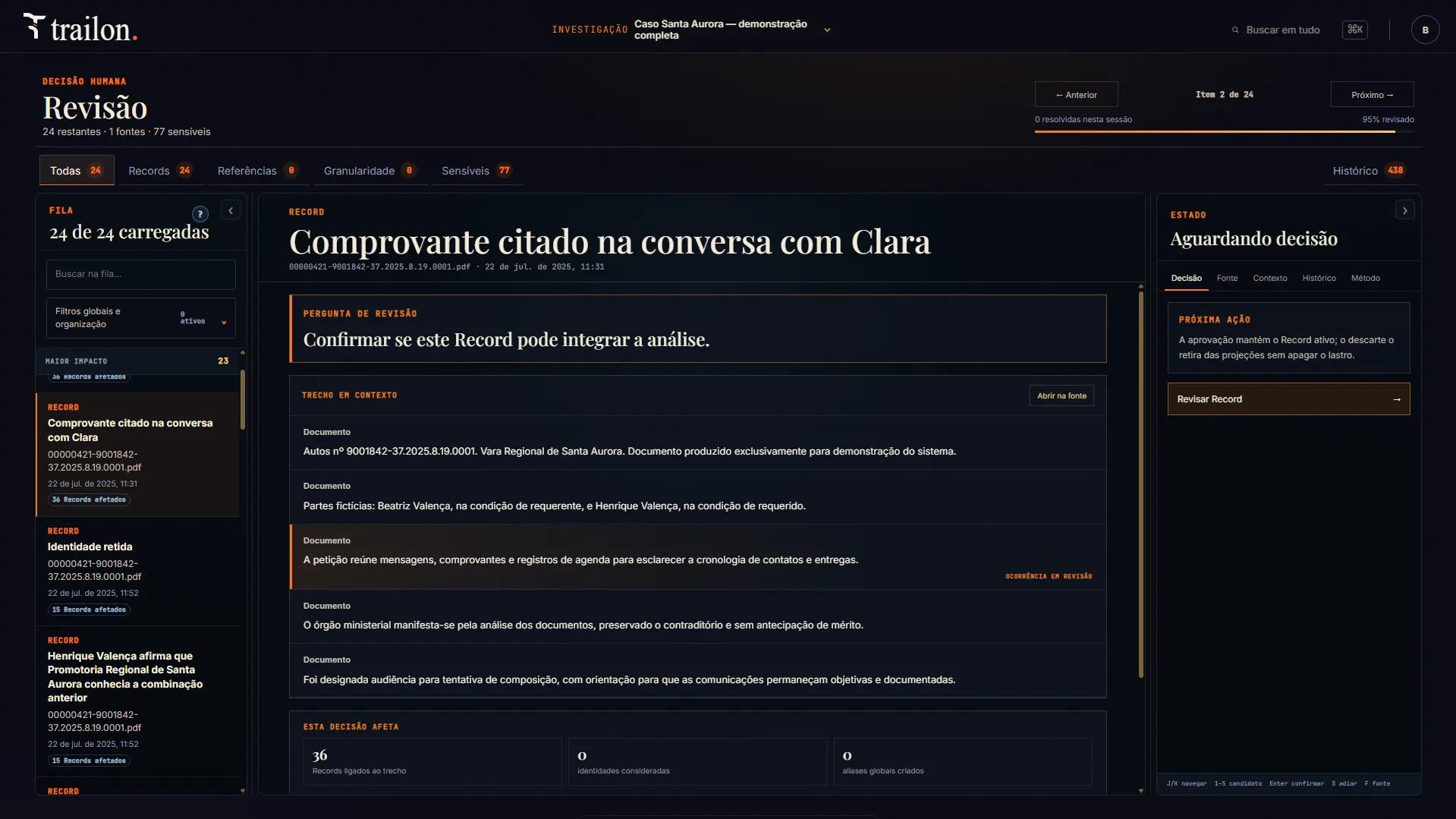
From argument to excerpt. No invisible leaps.
Trailon keeps reading, record, and source on the same path so a claim can be reviewed without losing case context.
Your case-management system stays where it is.
Deadline tracking, filing, billing, and document management continue doing their jobs. Trailon preserves the situation spanning those filings and systems.
Proceedings and repositories remain sources.
Trailon need not replace legal case or document-management systems.
Strategy no longer needs a parallel folder.
Arguments, accounts, and supporting material can stay organized over the same situation.
New evidence meets what it changes.
The case evolves without manually reconstructing every earlier line of reasoning.
What changes in case work.
Read across filings, exhibits, accounts, evidence, and decisions without maintaining a separate mental folder.
Every argument retains a path to the elements supporting or limiting it.
Material challenging a reading stays close enough to examine.
Event, allegation, evidence, and decision no longer collapse into one document sequence.
New material can change a reading without rewriting sources or erasing earlier states.
Someone else can understand why an argument came to matter, not just receive its files.
Do not hand over only the filings. Keep the whole case available for examination.
See how Trailon can connect accounts, evidence, decisions, and limits without replacing legal analysis.