


PROMISES, AGREEMENTS, AND PAYMENTS
The agreement may disappear in the conversation. The commitment does not.
A promise can begin in one message, change in another conversation, gain a deadline, acquire a receipt, and still leave something unresolved.
Trailon reconstructs what was agreed, by whom, when, what changed, and which records allow you to review its current state.
AgreementAttributionDeadlineChangesFulfillmentEvidence
Questions you can ask directly about what was agreed.
Search crosses messages, dates, people, amounts, changes, and receipts. You need not remember where each part appeared first.
Who made that commitment, and when?
Which deadline applied at the time?
Was the agreement changed later?
Is there confirmation or evidence of fulfillment?
What remains open?
Ask about the whole agreement. The platform retrieves available context and keeps a path to conversations, records, and excerpts that support or limit each answer.
The conversation was saved. The state of the agreement still needs reconstruction.
Add messages, audio, documents, or receipts and start the analysis. Trailon prepares commitments, people, dates, changes, and evidence before the next question.
Material enters with its origin, time, and identity preserved.
Conversations, documents, and receipts remain locatable after becoming part of the same situation.
The platform prepares commitments, conditions, deadlines, and related people.
Scattered material begins to form a reviewable state without manual assembly for each query.
Changes, ambiguities, and absences remain available for confirmation.
Automation organizes material; matters requiring judgment do not silently become conclusions.
Search directly across the agreement and its current state.
Every answer can return to records showing what was agreed, changed, fulfilled, or left open.
A promise is more than a sentence.
Who made it, what they promised, when, under which conditions, and what happened afterward form a structure that may cross many sources.
Changing an agreement need not erase what applied before.
A deadline is extended. An amount changes. A condition is added. Part of the agreement is fulfilled. Another part remains open.
Trailon preserves these states so a present-day reading does not flatten the earlier conversation into one retrospective account.
An agreement can change. Its history should show what applied at each moment.
An open item, non-fulfillment, and missing evidence are not the same thing.
The system organizes available material. It does not decide an agreement’s legal validity, responsibility, or effect, or fill gaps with a convenient answer.
Absence remains absence
Not finding a receipt does not automatically prove that payment never occurred.
Claims remain attributed
Saying something was fulfilled does not turn the statement into evidence of fulfillment.
State needs context
An obligation may have changed, been partly fulfilled, or depended on a still-open condition.
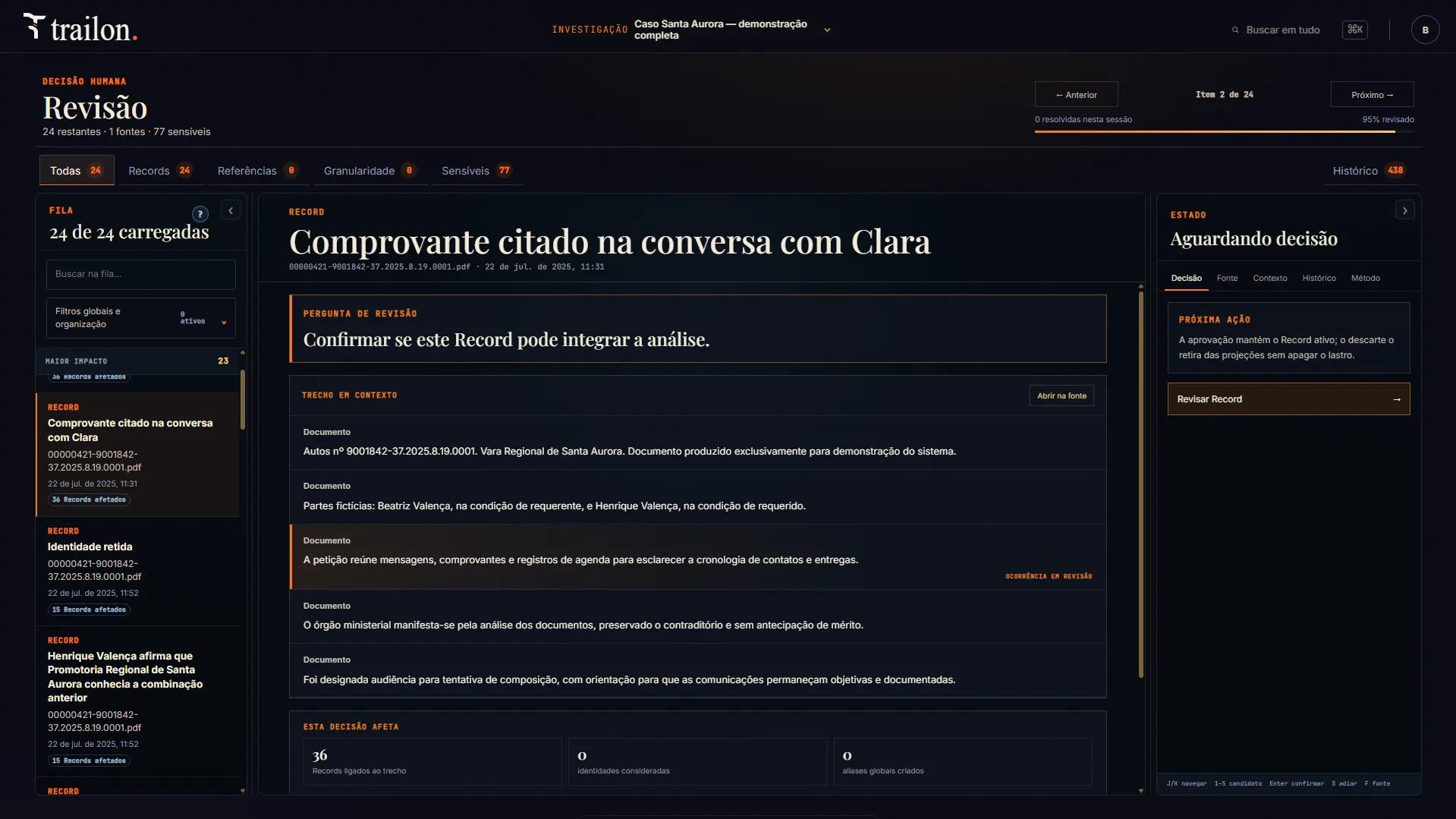
From an open item to the excerpt that explains why it is open.
A reading can lead to its record. The record can lead to the excerpt. The excerpt can lead to the original source—without asking you to trust an ungrounded summary.
Conversations and receipts remain where they are.
Trailon need not turn your records into an opaque narrative. It organizes a contextual layer over the material and preserves the origin of each part.
Messages and emailsWhere promises, changes, and confirmations appear.Audio and conversationsThe context in which conditions and expectations were expressed.DocumentsInstruments, proposals, and records formalizing part of the agreement.ReceiptsMaterial that may support payment, delivery, or another form of fulfillment.
Explore the platformWhat changes when an agreement no longer depends on remembering the conversation.
What was agreed no longer depends on the memory of people in the conversation.
New deadlines and conditions do not silently erase what applied before.
What remains unresolved can be found without rereading the entire history.
Payments, confirmations, and receipts stay linked to the relevant commitment.
Questions can span the full collection without knowing where to look first.
Every reading can return to the message, excerpt, or record needed to examine it.
Do not let an agreement depend on who still remembers the conversation.
See how Trailon can reconstruct promises, changes, payments, and open items while keeping a path to each source.